

Real Estate Agent vs. Broker vs. Realtor
FOLLOW US
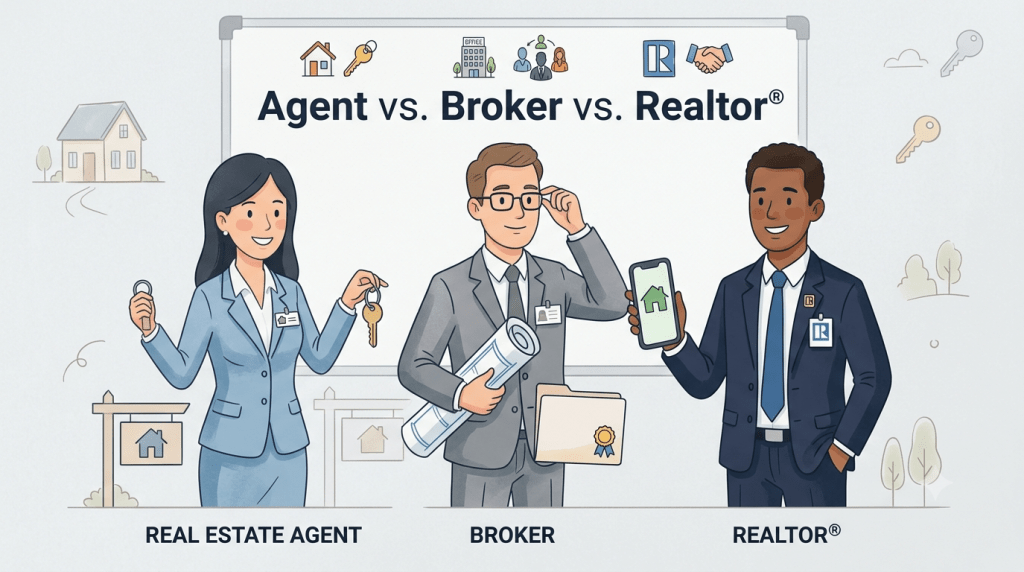
People use “real estate agent,” “broker,” and “realtor” like they mean the same thing. Well, they don’t! Each term refers to a specific license status, level of authority, or professional membership, and mixing them up can cost you points on your licensing exam or make you look uninformed with a client.
The good news? Once you see how the three connect, the confusion disappears for good. Here’s the breakdown of what separates a real estate agent from a broker from a realtor, and where the lines actually fall.
What Is a Real Estate Agent?
A real estate agent is anyone who holds an active real estate license and works under the supervision of a licensed broker. Agents can list properties, show homes, negotiate offers, and guide clients through a transaction, but they can’t operate independently. Every agent’s license is held by a sponsoring broker, and every transaction an agent handles is technically conducted under that broker’s authority.
This is the entry-level license in real estate. To become an agent, you complete pre-licensing coursework, pass your state’s licensing exam, and then affiliate with a brokerage. From there, most of your day-to-day work, contracts, disclosures, trust funds, runs through your broker’s oversight.
What Is a Real Estate Broker?
A broker, instead, has completed additional education and experience requirements beyond the agent level and passed a separate broker’s exam. Requirements vary by state, but brokers typically need a set number of years working as an active agent first.
The defining difference is independence. A broker can work alone, open their own brokerage, and supervise other agents. Some brokers choose to keep working as agents do, listing and selling property directly, while others focus on running a brokerage and managing the agents under their license.
There are a few designations worth knowing:
- Associate broker: A broker-level licensee who works under another broker.
- Managing broker: A broker who supervises agents or office operations.
- Principal broker: The person responsible for the brokerage’s licensed activity.
- Broker-owner: A broker who owns and operates a real estate company.
Same license, four different jobs. Worth knowing which one you’re dealing with, or which one you’re aiming to become.
What Is a Realtor?
Realtor, however, isn’t a license level at all. It’s a trademarked title that belongs to members of the National Association of Realtors (NAR). Both agents and brokers can become realtors by joining NAR and agreeing to its Code of Ethics, which sets standards for conduct beyond what state licensing law requires.
Membership isn’t automatic though. An agent or broker has to apply, pay dues, and commit to the code, so a licensed agent or broker who hasn’t joined NAR is not a realtor, even though they’re doing the same work day in and day out.
So think of it this way: agents and brokers tell you what someone’s licensed to do. The realtor tells you they’ve chosen to hold themselves to a higher bar on top of that.
Key Differences Between Agent, Broker, and Realtor
Laid out side by side, the differences are easy to spot. Here’s how the three stack up:
| Aspect | Real Estate Agent | Real Estate Broker | Realtor |
| What it is | Entry-level license | Advanced license with independence | Membership title, not a license |
| Can work independently | No, must operate under a broker | Yes, except for associate brokers | Depends, could be an agent or broker |
| Requirements | Pre-licensing course, state exam | Agent experience, broker course, broker exam | NAR membership, Code of Ethics agreement |
| Supervises others | No | Can supervise agents and other brokers | Not applicable |
| Governed by | State real estate commission | State real estate commission | State commission plus NAR |
An agent and a broker are always defined by license level. A realtor can be either one, the title just signals NAR membership on top of whatever license they hold.
Why the Distinction Matters
For exam takers, this comes up constantly. Questions will test whether you know that an agent can’t legally operate outside a broker’s supervision, or that “realtor” is a membership term rather than a license category. Missing this distinction is an easy way to lose points on questions that otherwise look straightforward.
If you’d rather build this kind of knowledge at your own pace, Lexawise has a full prep package where you can test yourself, track your progress, and go in feeling ready.
For working professionals, it affects how you present yourself and what you’re allowed to do. An agent advertising themselves as operating independently, without a broker’s name attached, is misrepresenting their license status, and that’s a real compliance issue, not just a technicality. Calling yourself a realtor without NAR membership is a trademark violation, not just casual imprecision.
For clients, understanding these terms helps set expectations. Working with a broker means working with someone who can make final decisions on a transaction without checking with anyone else. Working with a realtor means the professional has agreed to an ethics code that goes beyond state minimums, which can matter in a dispute.
Frequently Asked Questions
Still have questions? These are the ones that come up most.
What’s the main difference between a broker and a realtor?
A broker is a license level, someone who has passed additional exams and can work independently or run a brokerage. A realtor is a membership title through the National Association of Realtors. A broker may or may not be a realtor, depending on whether they’ve joined NAR.
What’s the difference between a real estate agent and a broker?
An agent holds a real estate license but must work under a sponsoring broker. A broker has completed further education and testing and can operate independently, including running their own firm and supervising agents.
Can a real estate agent be a realtor?
Yes. Agents and brokers can both join NAR and become realtors. License level and NAR membership are separate things, one has nothing to do with the other.
Do all real estate agents become brokers eventually?
No. Many agents stay at the agent level for their entire career. Becoming a broker requires extra coursework, exams, and usually a minimum number of years of experience, and plenty of agents have no interest in running a brokerage or supervising other agents.
Is a realtor more qualified than a regular agent?
Not necessarily in terms of license or skill. The realtor title reflects NAR membership and agreement to their ethics code, not a higher license level or additional required training.
Conclusion
At the end of the day, it’s simple: agent and broker are license categories set by the state. Realtor is a membership title layered on top of either one. That’s it, that’s the whole distinction. But knowing it cold keeps you sharp on your exam and confident with clients, especially on the day someone asks you to explain it on the spot and you don’t want to fumble.
The terms aren’t complicated once they click, and now they have. Want to see where you stand? Take our free real estate practice exam and choose your state to try questions like these under real exam conditions.
Every term you learn like this is one less thing standing between you and a passed exam. Keep going, you’re closer than you think.


