

California Real Estate Exam Study Guide (Free PDF) | 2026
FOLLOW US
Your California real estate exam study guide starts here, and if you’ve just finished your 135-hour pre-licensing coursework and looked up the CalDRE content outline for the first time, you already know what that moment feels like. One exam, 150 questions, 3 hours, and a pass rate that hovers around 50%. Half of the people who sit for this exam walk out without passing it.
The difference between the candidates who pass on the first attempt and the ones who don’t usually isn’t how much they studied. It’s what they studied and in what order. California’s exam is heavily weighted, one topic alone accounts for 25% of your score, and candidates who treat every section equally tend to lose points in exactly the areas that matter most.
This guide fixes that. Below you’ll find a full breakdown of the exam, a prioritized study approach, and everything you need to walk into the DRE testing center ready.
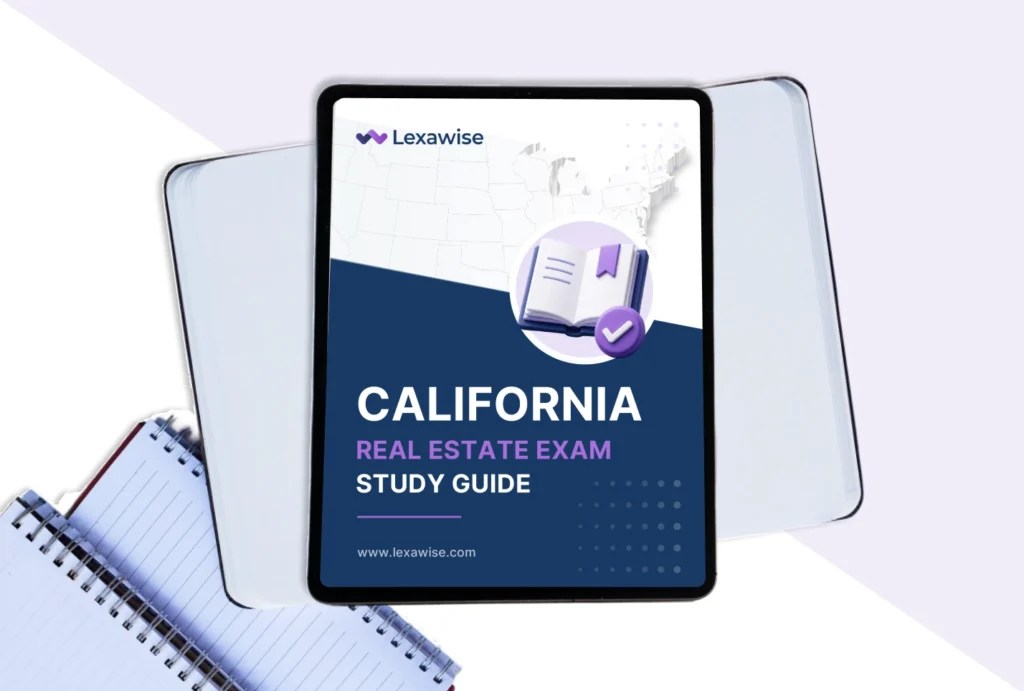
Download the Free California Study Guide here.
What Is the California Real Estate Exam?
The California real estate salesperson exam is administered directly by the California Department of Real Estate, not Pearson VUE, not PSI. California runs its own exam, and that difference matters more than most candidates realize. There is no national portion and no state portion. It’s one unified exam, 150 questions, covering California real estate law and practice from start to finish.
Here’s the full breakdown:
- Format: 150 multiple-choice questions.
- Time limit: 3 hours.
- Passing score: 70% — 105 out of 150 questions correct.
- Exam fee: $100.
- Testing locations: In person at DRE testing centers in Fresno, La Palma, Oakland, Sacramento, and San Diego.
Because California administers its own exam, there’s no Candidate Handbook from a third-party testing provider. The authoritative source for exam content is the CalDRE’s official content outline, published and updated directly in the official California Department of Real Estate’s website.
One thing that catches candidates off guard: you cannot sit for the exam until all three pre-licensing courses are complete and your application has been processed by the DRE. Processing can take several weeks, historically up to 6-8 in some periods after submission, check DRE’s current processing times page. If you’re planning your timeline, factor that window in, most candidates wait over a month between finishing their coursework and receiving an exam date.
If you fail the exam, you can retake it as many times as needed with no mandatory waiting period between attempts. The only hard deadline is that all attempts must occur within two years of your original application date, or you’ll need to reapply from scratch.
Learn more about California real estate license requirements if you need to.
What Topics Does the California Real Estate Exam Cover?
California’s exam is organized across seven topic areas, each weighted by the percentage of questions it contributes to your total score. Here’s the full breakdown
Practice of Real Estate & Disclosures
This is the heaviest section on the exam by a significant margin, nearly one in four questions. It covers trust fund handling, DRE licensing rules and disciplinary procedures, fair housing, advertising requirements, property management, and California’s disclosure forms. The Transfer Disclosure Statement (TDS) and Natural Hazard Disclosure (NHD) alone generate multiple exam questions and require specific knowledge of California law that no national study guide covers in enough depth.
Laws of Agency & Fiduciary Duties
Agency is the second-largest section and one of the hardest for California candidates. California has specific agency disclosure requirements, including the Agency Disclosure Form required in all 1–4 unit residential transactions, and dual agency rules that require written informed consent from both parties before proceeding.
California also uses terminology that differs from most national prep materials: the “selling agent” in California is the buyer’s agent, not the seller’s. That distinction alone trips up a meaningful number of candidates on exam day.
Property Ownership & Land Use Controls
This section covers California’s forms of ownership and vesting, including community property, community property with right of survivorship, joint tenancy, and tenancy in common; along with land use controls, government powers, and California-specific property tax law. Proposition 13 and Proposition 19 are both tested directly.
Property Valuation & Financial Analysis
Appraisal methods, principles of value, Gross Rent Multiplier calculations, NOI, cap rate, and CMA preparation. California’s fiscal year for property taxes runs July 1 to June 30; proration questions require you to know those dates cold.
Contracts
Contract law, listing agreements, purchase agreements, contingencies, and California-specific rules, including the outright prohibition on net listings under Business and Professions Code §10176, liquidated damages clauses in residential purchase agreements, and the Statute of Frauds as it applies to real estate.
Financing
Loan types, deeds of trust, TRID disclosure timelines, RESPA, Truth-in-Lending, and California’s loan brokerage rules. California uses deeds of trust, not mortgages, which affects how foreclosure works and what rights a borrower has after a trustee’s sale.
Transfer of Property
Deed types, title insurance (CLTA vs. ALTA), California’s escrow-based closing process, documentary transfer tax, 1031 exchanges, and special transfer processes including probate and foreclosure.
What makes California different from most other states isn’t any single topic. It’s the cumulative weight of California-specific rules layered across every section. Trust fund handling, the TDS and NHD, agency disclosure timing, community property vesting, Proposition 13 reassessment, the net listing prohibition, deeds of trust, documentary transfer tax, none of these appear on a standard national real estate prep course, and together they account for a substantial portion of the exam.
How to Study for the California Real Estate Exam
With 150 questions across 7 topic areas and a 50% first-time pass rate, the way you study matters as much as how long you study. Here’s what works.
Start with the exam weight, not the table of contents.
The single most important thing you can do before seeing a single flashcard is understand where the points are. Practice of Real Estate and Agency together account for 42% of your exam, nearly half your score. Transfer of Property accounts for 8%. If you study all sections for the same amount of time, you’ve already made a costly trade-off before you’ve answered a single question.
The free study guide PDF includes a Priority Table that assigns each topic a study hour allocation based on both its exam weight and its difficulty level, because a topic that’s 14% of the exam but conceptually hard needs more time than a topic that’s 15% but mostly procedural. Use that table before you build your schedule.
Follow a week-by-week plan, not a topic-by-topic marathon.
The free PDF includes a full 5-week study plan with a day-by-day schedule and a written explanation for why each week is structured the way it is. The short version:
- Week 1 goes deep on Practice of Real Estate, the heaviest and widest topic, because it sets the foundation for everything else.
- Week 2 covers Agency in full.
- Weeks 3 and 4 work through Property Ownership, Valuation, Contracts, Financing, and Transfer of Property in a sequenced order that builds on what came before.
- Week 5 is entirely practice exams, weak-area review, and the final checklist.
If you’re on a tighter timeline, the plan also notes how to compress into 4 weeks, though for California specifically, 5 weeks is the stronger recommendation given the exam’s breadth.
Take practice exams before you think you’re ready.
California’s exam is 150 questions in 3 hours, about 72 seconds per question. That’s not a lot of margin for second-guessing yourself, working through confusion, or reading a question three times before you understand what it’s asking. The only way to build the speed and decisiveness you need on exam day is to practice under timed conditions well before exam day.
Lexawise’s California practice exams are built around the CalDRE content outline, with questions across all seven topic areas and detailed explanations for every answer.
If you prefer studying offline, you can also download a free set of California real estate exam questions in PDF format, useful for reviewing on paper and identifying which topic areas need more attention before you sit for the timed version.
Don’t rely on national prep materials for California-specific content.
This is the most common mistake California candidates make. Generic study courses cover real estate principles well. They do not cover the Agency Disclosure Form’s timing requirements, the six hazard zones on the NHD, the trust fund deposit deadline, the net listing prohibition, community property with right of survivorship, Proposition 13 reassessment triggers, or documentary transfer tax calculations, all of which are tested on the California exam. The free study guide PDF covers every one of these in the relevant topic section.
Download Your Free California Real Estate Exam Study Guide
The Lexawise California Real Estate Exam Study Guide covers everything in this post, organized into a printable PDF you can work through section by section. Here’s what’s inside:
- Full exam overview — structure, timing, scoring, testing locations, and California-specific notes on the application process.
- Topic-by-topic study content across all 7 CalDRE exam areas, with California-specific rules called out throughout.
- Key terms and plain-English definitions for every major concept.
- A prioritized 5-week study plan with a day-by-day schedule and reasoning for how each week is built.
- Section recaps that test your recall before you move on.
- A pre-exam checklist covering all 7 topic areas with California-specific checkpoints.
- Post-exam next steps — what to do after you pass, including first-renewal CE requirements.
It’s free. No course purchase required. Download the Free California Study Guide.
Frequently Asked Questions
Here are four of the most asked questions about the California real estate exam.
How hard is the California real estate exam?
California has one of the lowest first-time pass rates in the country, roughly 48 to 52% statewide. It’s harder than most candidates expect, not because the material is impossible, but because California layers state-specific rules on top of general real estate principles in a way that generic prep courses don’t prepare you for.
How many questions are on the California real estate exam?
150 multiple-choice questions. You have 3 hours to complete the exam and need to answer at least 105 correctly, a 70% passing score.
How long should I study for the California real estate exam?
Most candidates are ready after 5 to 8 weeks of focused preparation following their 135-hour pre-licensing coursework. The study plan in the free PDF is built for 5 weeks at roughly 13 hours per week, about 2 hours per weekday with a lighter weekend review session. Keep in mind that DRE application processing takes historically 6 to 8 weeks after you submit your coursework, so your total timeline from finishing pre-licensing to sitting for the exam is typically 2 to 3 months. Use that processing window to get ahead on your prep rather than waiting until you have an exam date in hand.
What happens if I fail the California real estate exam?
You can retake the exam as many times as needed with no mandatory waiting period between attempts. The only deadline is that all attempts must occur within two years of your original application date, after that, you’ll need to reapply and pay the fees again. The $100 exam fee applies to each attempt. After each failed attempt, the DRE provides a score report identifying which topic areas you missed the most questions in. Use that report to direct your next round of prep rather than starting over from scratch. Targeted review of your weak areas is almost always more effective than reviewing everything again from the beginning.
Conclusions
Passing the California real estate exam comes down to knowing where the points are and putting your study time there. Practice of Real Estate and Agency alone are 42% of your score. The free study guide is built around that reality, every section, every hour allocation, and every week of the plan reflects the actual exam weight, not a generic outline.
Or start with a free California practice exam right now and see exactly where you stand before you open the first topic section.


