

Joint Tenancy vs Tenancy in Common: Real Estate Exam Guide
FOLLOW US
If you are studying joint tenancy vs tenancy in common for the real estate exam, the fastest way to separate them is to look for the clue hidden in the question. Joint tenancy usually points to right of survivorship and, under the traditional exam rule, equal ownership interests. Tenancy in common usually points to no survivorship and ownership shares that may be equal or unequal.
The exam usually gives you a short scenario and asks you to identify the ownership form, what happens after death, or what changes after a transfer.
Key Terms to Know First
Before working through exam scenarios, make sure you can recognize the basic terms used in questions about co-ownership. You do not need a long legal definition of each one, but you should know what each term signals.
- Joint tenancy: A form of co-ownership that traditionally includes equal ownership interests and a right of survivorship.
- Tenancy in common: A form of co-ownership in which ownership shares may be equal or unequal, and there is no automatic right of survivorship.
- Right of survivorship: The feature that allows the surviving joint tenant or tenants to continue ownership after another joint tenant dies.
- Co-tenant: A person who owns property together with one or more other owners.
- Severance: A change that can end a joint tenancy as to one owner’s interest, such as a transfer to a third party.
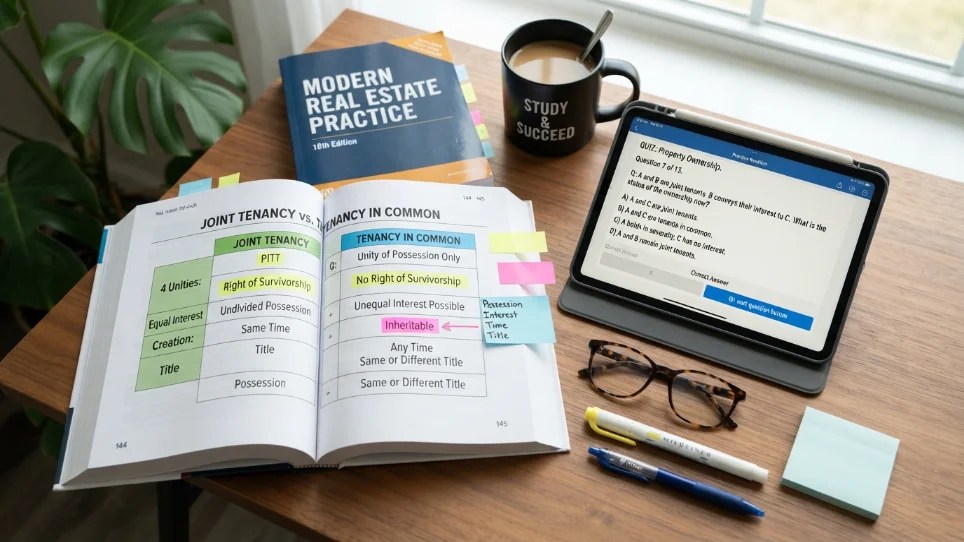
- Four unities: The traditional joint tenancy requirements of possession, interest, time, and title, commonly remembered as PITT.
These terms will appear again in the examples below. On the exam, the challenge is usually not defining them; it is recognizing which one applies to the facts in the question.
How the Exam Tests the Difference
For exam purposes, start by identifying the fact that actually distinguishes the two ownership forms. The question may focus on right of survivorship, ownership shares, the four unities, or a transfer of interest. A death scenario is one common pattern, but it is only one of several clues the exam may use.
Here is the comparison worth memorizing:
| Exam clue | Joint tenancy | Tenancy in common |
| Right of survivorship | Yes, generally | No |
| Ownership shares | Equal under the traditional exam rule | May be equal or unequal |
| Death of an owner | Survivors receive the deceased owner’s interest | No automatic survivorship; the interest may pass through the deceased owner’s estate |
| Four unities | Look for time, title, interest, and possession | The four-unities test does not apply |
| Transfer by one owner | May sever the joint tenancy as to that interest | Owner can transfer their individual interest |
| Possession | Each co-owner can possess the whole property | Each co-owner can possess the whole property |
These are the traditional rules commonly tested on real estate licensing exams. Property ownership and title rules can vary by state, so follow any state-specific rule given in the question.
Example: Ana and Marcus own a property together. The question says that when Ana dies, Marcus automatically receives Ana’s ownership interest. The important clue is not that they own the property together. The word automatically points to right of survivorship and therefore to joint tenancy.
The broader topic of forms of concurrent ownership can help you review how the ownership forms work, but exam questions usually test whether you can apply the rules to a short fact pattern.
Right of Survivorship on the Exam
Questions comparing tenancy in common vs joint tenancy often include several facts, but only one or two facts actually decide the answer. Train yourself to identify those facts before looking at the answer choices.
Most questions fall into a few recognizable patterns. When you read the scenario, check for these clues:
- Death of a co-owner
- Right of survivorship
- Unequal ownership percentages
- Same or different acquisition times
- Same or different title
- Equal ownership interests
- Transfer of one owner’s interest
- Language about heirs, a will, or an estate
Example: Three investors own a building. One owns 50%, while the other two own 25% each. All three can use the entire property. The possession language may sound important, but the unequal ownership shares are the stronger clue. Under the traditional exam rule, the best answer is tenancy in common.
Property ownership is only one part of the test, so understanding what is mostly on the real estate exam also helps you see how these questions fit alongside contracts, agency, financing, and other heavily tested areas.
What to Expect in Exam Questions
Questions about joint tenancy and tenancy in common usually come as short fact patterns. The exam may change one detail, such as what happens after an owner dies, how the ownership percentages are divided, or whether one owner transfers an interest.
One of the most common patterns involves the right of survivorship. In a traditional joint tenancy, a deceased owner’s interest does not pass through the estate in the same way it would in a tenancy in common.
Death Scenario Questions
Consider this exam-style question:
Maria and Devon own a property. Maria dies, and her ownership interest passes according to her will. Which form of ownership best fits the facts?
The best answer is tenancy in common.
Now change one fact:
Maria dies, and Devon automatically becomes the surviving owner of Maria’s interest through survivorship.
That points to joint tenancy with right of survivorship.
Multiple-Owner Questions
The exam can make the same rule slightly harder by adding a third owner.
Example: Alex, Brooke, and Cameron own a property as joint tenants, each with a one-third interest. Brooke dies. What happens to Brooke’s share?
Under the traditional joint tenancy rule, Brooke’s interest does not pass to an heir through her estate. Through the right of survivorship, Alex’s and Cameron’s ownership shares increase from one-third to one-half each.
When you see three or more owners, focus on who holds the ownership interest after one owner dies. That is usually the fact the question is testing.
Ownership Shares on the Exam
Percentage questions are another common exam format. Under the traditional rule commonly taught for joint tenancy, the owners have equal interests, while tenants in common may hold equal or unequal ownership shares.
Do not assume that equal possession means equal ownership. Tenants in common can own unequal shares and still have the right to occupy and use the whole property.
Example: Ava owns 70% of an investment property and Noah owns 30%. Both have the right to possess the entire property.
The best exam answer is tenancy in common.
The 70/30 split is the stronger clue because both forms of ownership can include the right to possess the whole property. In exam questions, possession may be a true but distracting fact.
In California, property ownership and land use controls make up about 15% of the salesperson exam, and types of ownership are included in that category. If you are taking this state’s exam, California real estate exam prep lets you practice ownership questions alongside the other topics in the state’s exam outline.
The Four Unities of Joint Tenancy: PITT
You should know the four unities, but the exam may never use the term “four unities.” Instead, it may describe the facts and expect you to recognize them.
A simple memory tool is PITT. The letters stand for the four traditional joint tenancy elements:
- Possession: Each joint tenant has the right to possess the whole property.
- Interest: The ownership interests are equal.
- Time: The owners acquire their interests at the same time.
- Title: The owners acquire their interests through the same title or instrument.
The exam can also test PITT by breaking one of the traditional unities.
Example: Eli receives his ownership interest in January. Grace receives hers six months later. The different acquisition dates should make you notice that the traditional unity of time is missing.
The same logic applies to title. If two co-owners receive their interests through different conveyances rather than the same instrument, that fact points away from traditional joint tenancy and should make you consider tenancy in common.
A useful shortcut is to read PITT in both directions. Same time, same title, equal interest, and shared possession are traditional joint tenancy clues. Different acquisition times, different conveyances, or unequal interests should make you consider tenancy in common.
How Severance Appears on the Exam
Some questions begin with a valid joint tenancy and then tell you that one owner sold or transferred an interest. The tested concept is often severance.
Under the traditional rule, transferring a joint tenant’s interest can terminate the survivorship feature as to that transferred interest. The person receiving the transferred interest generally becomes a tenant in common with the other owners. If there are other original joint tenants, they may remain joint tenants with each other.
Example: Chris, Ben, and Taylor own a property as joint tenants. Chris transfers their interest to Jordan.
Jordan generally holds the transferred interest as a tenant in common. Ben and Taylor can remain joint tenants with each other. Jordan does not simply replace Chris as another joint tenant.
That gives you a useful exam pattern:
Joint tenancy → one owner transfers an interest → severance as to that interest → transferee becomes a tenant in common
A question may ask what happened to the ownership form rather than using the word “severance.” Focus on the transfer and identify the new relationship between the owners.
Florida’s real estate education framework specifically includes property rights, estates, tenancies, joint tenancy, tenancy in common, and right of survivorship. If you are preparing for that exam, Florida real estate exam prep can help you practice these ownership concepts alongside the other topics you will need to know.
Common Exam Traps
Real estate exam questions often give you a fact that is correct but does not distinguish between the answer choices. That is where students lose easy points.
Before choosing an answer, ask which fact actually separates joint tenancy from tenancy in common. These clues deserve the most weight:
- Automatic transfer to the surviving owner after death: Joint tenancy
- Interest passes through an estate: Tenancy in common
- Unequal ownership shares: Usually tenancy in common under the traditional exam rule
- PITT facts: Look closely at joint tenancy
- Transfer by a joint tenant: Possible severance
- Equal right to possess: Could describe either ownership form
Example: Sam and Riley each have the right to possess a property. Sam owns 75%, and Riley owns 25%.
If you focus only on possession, you may get the question wrong. The unequal percentages are the stronger clue, so tenancy in common is the best answer.
A 3-Step Way to Answer These Questions
You do not need to recite every ownership definition each time you see a question. A short process is faster and easier to repeat under exam pressure.
Use the same three steps every time:
- Find the clue. Look for death, percentages, PITT facts, or a transfer.
- Connect the clue to the rule. Survivorship suggests joint tenancy. Unequal interests or an estate transfer suggests tenancy in common.
- Ignore neutral facts. Shared possession alone does not decide the question.
Applying the same process across topics is easier when your real estate exam study strategy combines vocabulary review with practice questions instead of memorizing definitions in isolation.
Example: Two investors each own 50% of a property and can both possess the whole property. One investor dies, and their share passes to their daughter through the estate.
The 50/50 ownership could distract you. The deciding fact is what happens after death, which points to tenancy in common.
If you keep missing this type of question, use the real estate license exam prep practice tools to review results by topic and see whether property ownership is actually one of your weaker areas before spending more time on it.
Frequently Asked Questions
A few related terms can appear around joint tenancy questions even when they are not the main concept being tested. Knowing what they mean can keep unfamiliar wording from slowing you down.
What does JTWROS mean on the real estate exam?
JTWROS stands for joint tenancy with right of survivorship. If you see the abbreviation, focus on what happens to an owner’s interest at death.
Is tenancy by the entirety the same as joint tenancy?
No. Tenancy by the entirety is a separate form of shared ownership associated with married couples in jurisdictions that recognize it. Its exact rules depend on state law.
Can tenants in common own 50/50?
Yes. Tenancy in common allows unequal ownership shares, but it does not require them. Two tenants in common can each own 50%, so equal percentages alone do not prove that a joint tenancy exists.
Final Thoughts
For the real estate exam, you do not need to memorize every detail of property law. You need to recognize the clue that changes the answer.
Think right of survivorship and PITT when you see joint tenancy. Think unequal ownership shares, an interest passing through an estate, or different acquisition details when you see tenancy in common.
When survivorship, unequal shares, PITT, and severance start feeling easy to recognize, test yourself with a free real estate practice exam. Use the missed-question explanations to identify which clue you overlooked, then retest until you can spot the ownership form quickly.


